The word “superfood” should make you suspicious. It is a marketing term, not a clinical one, and most foods that get slapped with it are ordinary plants whose virtues have been inflated by people selling powders. Blueberries are a useful case study because they are one of the few foods where the gap between the marketing and the evidence is small.
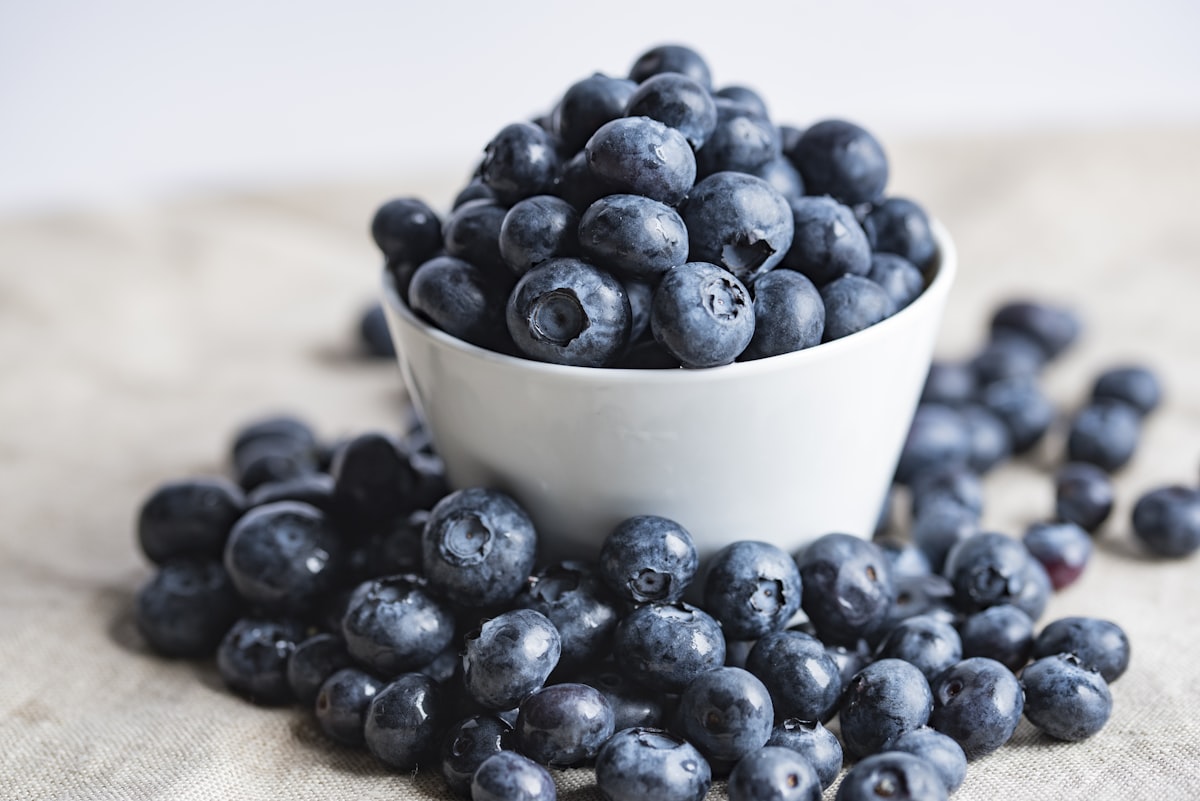
What is actually in a blueberry
The pigment that makes a blueberry blue is a class of polyphenols called anthocyanins. The same family of compounds appears in blackberries, black rice, red cabbage, and aronia. Anthocyanins are not vitamins — your body does not strictly need them — but they appear to act as signaling molecules that nudge the vascular endothelium and the brain in measurable ways.
A typical cup of fresh wild blueberries delivers somewhere in the range of 300 to 600 mg of anthocyanins, plus roughly 4 g of fiber, vitamin C, and a small dose of vitamin K. Cultivated blueberries land lower on the anthocyanin scale but higher on yield and shelf life — both are worth eating.
What randomized trials show
There are three threads of human data worth knowing.
The first is vascular. A series of crossover trials at King’s College London found that drinks containing about 200 g of blueberries acutely improved flow-mediated dilation — a marker of endothelial function — within two hours of consumption, with the effect tracking the appearance of anthocyanin metabolites in the bloodstream.1 Habitual intake studies suggest the effect is durable over months.
The second is cardiovascular outcomes. A prospective analysis of more than 90,000 women in the Nurses’ Health Study II found that women who ate three or more servings a week of blueberries and strawberries had a 32 percent lower risk of myocardial infarction over 18 years compared with women who rarely ate them, after adjusting for the usual confounders.2 Observational data is not causal, but the magnitude is large enough to take seriously.
The third is cognitive. A small but well-designed trial at the University of Cincinnati gave older adults with mild cognitive complaints a daily blueberry juice equivalent to about one cup of berries for 12 weeks. The treated group showed improvements on paired associate learning and word list recall.3 Acute studies in children using wild blueberry drinks found short-term improvements on executive function tasks within hours.4
How to think about the dose
The clinical work clusters around a serving of roughly 150 to 200 g of berries per day — about a cup. Frozen wild blueberries are an unusually good buy: they have higher anthocyanin density than fresh cultivated berries, and freezing locks in the polyphenols. Eating them daily for years is the realistic intervention; eating them once for a photograph is not.
A practical default is one cup of frozen wild blueberries in the morning — folded into yogurt, oats, or a smoothie. It costs roughly a dollar per serving, requires no preparation, and is one of the few dietary moves with both mechanistic and outcome data behind it.
Where the hype outruns the evidence
Be honest about what blueberries cannot do. They will not undo a sedentary lifestyle, a poor sleep schedule, or a diet built around ultra-processed food. The cognitive effects are statistically significant but modest, and most of the studies are short. The cardiovascular signal is strong but observational. None of this is a reason to skip blueberries; it is a reason to fold them into a broader pattern of plant-forward eating rather than treating them as a single-ingredient solution.
The honest summary is this: blueberries are cheap, shelf-stable in the freezer, supported by both mechanistic and clinical data, and pair well with the rest of a Mediterranean-style diet. That is more than can be said for almost anything else labeled a superfood.